Since September 2023, the Legal Development Network has been running LINK, a mechanism for local coordination of humanitarian response, in partnership with the Czech humanitarian organisation People in Need and with funding from the UK Government. In 11 de-occupied communities of Mykolaiv Oblast, LINK has recorded 4,499 needs of local residents, and almost half of them have already been met. This analysis looks at how these needs have changed over three years, what happened in Q3 2026, and how local self-government bodies and civil society, charitable and international organisations work together to support residents of de-occupied communities.
Bilozirka: three years in the life of one village
The village of Bilozirka in Zavodske community is Mykolaiv Oblast in miniature. Over three years, the community has reported 30 needs of village residents to LINK. Of these, 12 have been met, 16 have lapsed, and two remain open.
The community submitted its first requests in December 2023, and they concerned reconstruction: 398 windows for damaged homes, 46 windows for the village council and a dormitory, and drinking water at 40 litres per household per month. In autumn 2024, the community added requests for firewood for 164 households without gas, and for repairs to 20 damaged roofs and 50 entrance doors. No provider was found for any of these needs, and all of them eventually lapsed.
The first need to be met was for hygiene kits, one for each of the village’s 427 households. The community submitted it on 30 August 2024, and within a month two organisations, the Pomagaem Charitable Foundation and International Medical Corps, had covered it.
In 2023–2024, the community reported large needs for the whole village: windows, roofs, firewood. In 2026, it mostly submits targeted requests for specific people. In early June, the community submitted six requests for seriously ill residents, people with limited mobility and displaced families: orthopaedic mattresses, adult diapers, incontinence pads, blankets and bed linen. The Volunteer Corps Charitable Organisation met all six within two to three days.
A request for 422 hygiene kits has been waiting since October 2025. In August 2026, the community reported a need for 29,800 litres of drinking water: the village has a water treatment plant, but it has been out of service since July. Project HOPE covered this drinking water need in full in September 2026.
What is happening with Bilozirka’s requests can be seen across the oblast. Requests for housing repairs and heating lapsed without a response. Partners meet targeted needs of specific people within days. Water, sanitation and hygiene needs wait the longest: the village’s request for hygiene kits has been open since October 2025.
Assistance has accelerated
Needs come from 181 settlements. As of 1 October 2026, 2,210 needs (49%) had been met. Another 1,200 (27%) lapsed without ever receiving assistance, and 1,086 (24%) are still open.
New needs are met faster than those submitted in 2024–2025. This reflects well-established cooperation with humanitarian organisations, which have defined their priority areas and now respond to requests more promptly. Of the needs submitted in 2023, only 14% were met, while 73% never received assistance. The share met rises to 29% for needs submitted in 2024, 53% for 2025 and 78% for 2026. Waiting times have also fallen sharply: the median time to meet a need was 290 days for needs submitted in 2023, compared with six days for those submitted in 2026.
Q3 2026: the highest number of needs met
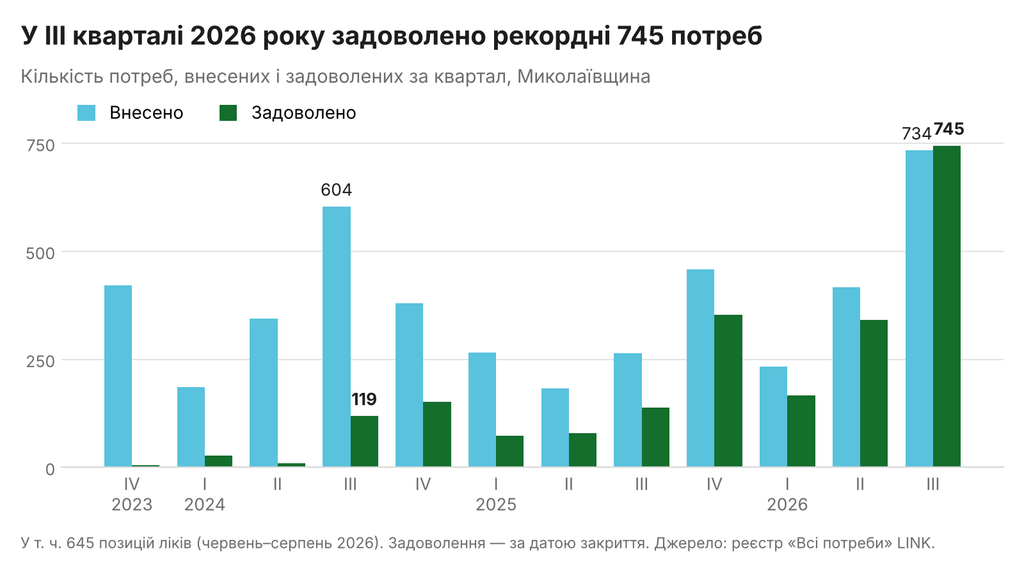
In July–September 2026, communities submitted 734 needs, and partners met 745, twice as many as in Q2. Of the needs met, 143 had been submitted in previous quarters, including 36 dating back to 2024.
Of the 734 new needs, 517 are individual medicine items for feldsher-midwife stations (FAPs). Communities submitted 217 other needs, compared with 290 in Q2, and partners met 188 of these, compared with 240. The median time to meet these needs was 25 days, up from 17.5 days in Q2.
Where requests increased. Snihurivka community submitted 240 needs (70 in Q2), Bereznehuvate 122 (45 in Q2) and Bashtanka 102 (5 in Q2). Most of these were medicines. The largest numbers of needs met were in Snihurivka (250), Shevchenkove (186, compared with 11 in Q2) and Bashtanka (108) communities. By contrast, in Zavodske, Voskresenske and Horokhivske communities, 43, 41 and 19 needs were met in Q2, but only 3, 4 and 2 in Q3. Halytsynove and Shyroke communities submitted one need each.
What remained unanswered. Of the needs submitted in Q3, 130 have not yet been met. Almost half of them (59) relate to water, sanitation and hygiene, a further 38 to health, and 30 to housing and non-food items. Only three heating requests were received ahead of the heating season, and none of them has been met.
Who delivered. International organisations made 15 deliveries through LINK, a quarter of the Q2 figure (59). The Mykolaiv charitable association “Peace through Spiritual Revival” and Age Concern Ukraine met needs in Mykolaiv Oblast through the LINK booking register for the first time, and the Vezha Charitable Foundation returned after a break. However, three quarters of the quarter’s deliveries were made by a single foundation, the Medical Aid Committee in Zakarpattia.
Where needs are concentrated
Three communities, Bereznehuvate (878 needs), Shevchenkove (749) and Snihurivka (722), account for 52% of all needs in the oblast. The largest numbers of open requests are in Shevchenkove (221), Bereznehuvate (211) and Bashtanka (156) communities.
The number of needs depends not only on the size of a community but also on how many villages it collects information from. In Bereznehuvate community, needs come from 40 settlements; in Halytsynove, from only six.
Needs are met most often in Inhulka (65%) and Voskresenske (57%) communities, and least often in Shyroke (23%) and Mishkovo-Pohorilove (26%). In these two communities, almost half of all needs lapsed without a single delivery.
Communities submitted the most needs in summer 2024 (604 in Q3) and summer 2026 (734). For a long time, partners met far fewer needs than were coming in. The gap narrowed markedly from Q4 2025, and in Q3 2026 the number of needs met exceeded the number of new needs for the first time.
From survival to treatment
Over three years, the needs reported by communities in Mykolaiv Oblast have changed fundamentally. In autumn 2023, they most often concerned housing, non-food items and heating. In 2026, most requests relate to health.
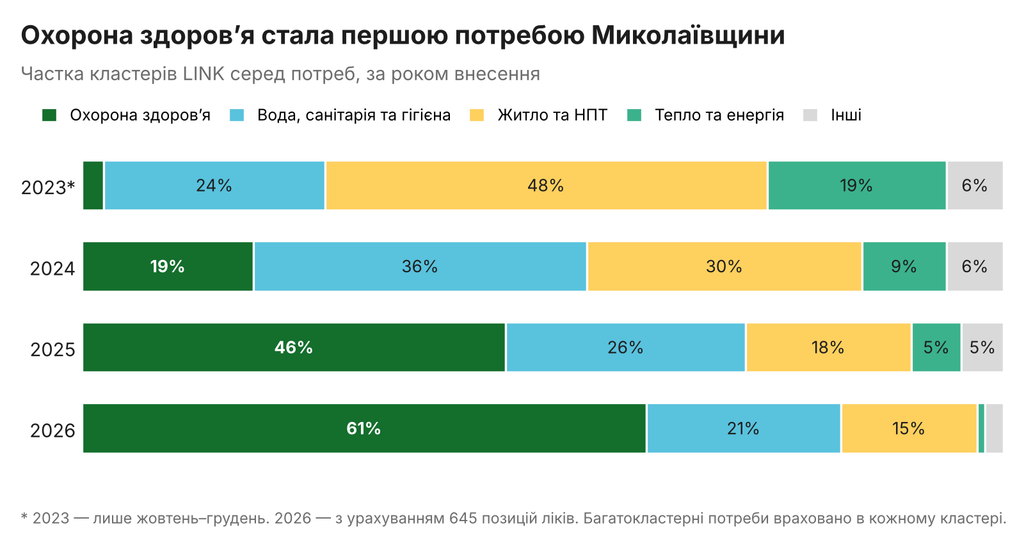
Health requests have increased for two reasons. First, the needs themselves have changed: once basic household issues are more or less resolved, communities move on to rehabilitation aids, medical equipment and the fitting-out of FAPs and outpatient clinics. In 2025 alone, communities submitted 157 requests to equip FAPs and outpatient clinics and 131 for mobility aids (crutches, walkers, wheelchairs).
Second, this is how records are kept. In June–August 2026, 645 medicine items for 13 settlements in five communities were entered in the register: Snihurivka (278), Shevchenkove (114), Inhulka (97), Bashtanka (94) and Bereznehuvate (62). Each medicine is recorded as a separate need, so a single delivery to a FAP produces dozens of entries.
Water, sanitation and hygiene (WASH) requests account for between 21% and 36% of the total each year. They most often concern hygiene kits (441 needs over the whole period), adult diapers (264) and baby diapers (164), drinking water, and water supply equipment.
Heating: a need that disappears rather than gets met
Needs for heating, gas and electricity are the least likely to be met in Mykolaiv Oblast. Of 298 such needs, only 19 (6%) have been met, while 207 (69%) have lapsed. Firewood shows this most clearly: of 156 requests, five were met, and the remaining 151 lapsed with the end of the heating season.
The share of heating requests fell from 20% to 1%, but this does not mean the problem has been solved. In part, this is because health requests have grown considerably. But the number of heating requests has also fallen: from 139 in 2024 to only 12 in 2026.
We see two possible explanations. Either communities have stopped submitting requests that went unanswered for years, or winter needs are increasingly covered by the wider humanitarian coordination system, and LINK, which works with overlooked and unmet needs, receives only those that the system has missed¹.
Among the 72 open needs in this cluster, the most common request is for portable power stations (42). Communities are preparing in advance for power outages in winter 2026–2027.
Not all needs are equally likely to find a provider
Once a partner takes on a need, it almost always delivers. Of 2,302 bookings, 2,289 were fulfilled in the promised volume, and 94.5% of deliveries took place on or before the date agreed with the partner.
The problem lies elsewhere: some needs never find anyone willing to take them on.
Health needs are met most often, at 74%, and half of them within six days. The fulfilment rate is 56% for food requests, 42% for WASH, and 32% for housing and non-food items. The lowest rates are for heating (6%), services (4%) and animal care (8%).
WASH needs wait the longest: the median time to meet them is 37 days. Besides hygiene kits, this cluster includes water supply equipment, which is harder to procure and deliver. By comparison, the median time is 10 days for housing, 14 for heating and 15.5 for food.
What lapsed
Of the 1,200 needs that lapsed, 965 were submitted by communities back in 2023–2024. They most often concerned firewood (151 needs), hygiene kits (131), adult diapers (117), building materials for repairs such as windows, slate, beams and rafters (103), mobility aids (65), drinking water (34), cash assistance (30) and food kits (26).
We see three reasons:
- firewood, wood-burning stoves and generators are needed in winter, and once winter is over the request no longer makes sense;
- for costly repairs and infrastructure, such as roofs, windows and water towers, no partner with a sufficient budget can be found;
- the large volume of household requests in 2024 arrived when partners were taking on far fewer needs: 354 bookings in 2024, compared with 1,294 in 2026.
The “no longer relevant” status does not mean that the problem has been solved. It only records that the community no longer confirms the request. People may have received help from other sources, moved away or stopped waiting.
What is still waiting
Of the 1,086 open needs, 677 (62%) were submitted by communities more than a year ago, and half of all open needs have been waiting for over 564 days. The most common unmet needs are hygiene kits (91), mobility aids (59), adult diapers (52) and baby diapers (45), water supply equipment (43), portable power stations (42), FAP equipment (29) and solar panels (27). Of the open needs, 224 are marked as high priority.
Who identifies a need and who meets it
Communities themselves are the first to identify and assess a need: social workers, starostas, and heads of communities and military administrations. They determine what is needed, how much and for whom, and regularly confirm that a request is still relevant. LINK specialists verify this information and look for providers, while civil society, charitable and international organisations deliver the assistance.
Cross-sector cooperation in LINK means resolving one person’s complex situation jointly, through humanitarian, legal and social support, so that they do not have to seek help in three different places.
In Shevchenkove community, LINK lawyers are providing accompaniment to a family in which the father is raising the children alone and cannot complete the inheritance process. Legally, the case was clear, but legal and notary costs came to about UAH 60,000, which the family did not have. The lawyers assessed both the legal and the financial side of the case, approached the Norwegian and Danish Refugee Councils, and secured the partners’ agreement to take it on. Earlier, when a baby was born in the family, the child received humanitarian assistance through LINK’s mediation.
Another case shows how the mechanism works across oblasts. A person injured in a war-related incident in Kherson Oblast needed medical supplies, transport to a hospital in Mykolaiv and documents to obtain the relevant status, all at the same time. These needs could not be separated: without transport there is no treatment, without documents no status, and without status no further support. LINK referred the case to the Danish Refugee Council and coordinated the assistance: the person received medical supplies, was taken to hospital and was helped to prepare the documents.
The connection between LINK’s humanitarian and legal components works both ways. Across the mechanism as a whole, 5.6% of legal requests came from humanitarian needs managers and partner organisations. In Mykolaiv Oblast, the most legal requests were recorded in Bashtanka (96), Bereznehuvate (69), Shevchenkove (63), Snihurivka (53) and Horokhivske (24) communities. Bereznehuvate, Shevchenkove and Snihurivka are also the three communities with the most humanitarian needs.
Community representatives in LINK
Through the community account on the LINK platform, representatives of even remote villages can enter needs that nobody else has noticed or met. Each such need is then verified with at least two sources. The account has 53 registered community representatives from Mykolaiv Oblast. Most of them are staff of social protection departments and social service centres (18), heads and staff of community and military administrations (15), and starostas (13). The rest are staff of cultural institutions (3), activists and heads of civil society organisations (3), and a FAP worker (1).
Social workers and starostas have become the main sources of information about needs in villages. However, the community account is still little used: of the 2,569 needs for which the entry channel is known, only 56 (2.2%) came through it. Communities report the rest to LINK data collection specialists, who are in contact with 134 community representatives.
Who fulfils bookings
A single foundation, the Medical Aid Committee in Zakarpattia, fulfilled 916 bookings, or 40% of the total. It did not work in Mykolaiv Oblast in 2024, but it fulfilled 25% of bookings in 2025 and 58% in 2026. This foundation met 644 of the 645 medicine items and 125 needs related to equipping FAPs and outpatient clinics. It accounts for 76% of bookings in Snihurivka community and 56% in Bashtanka.
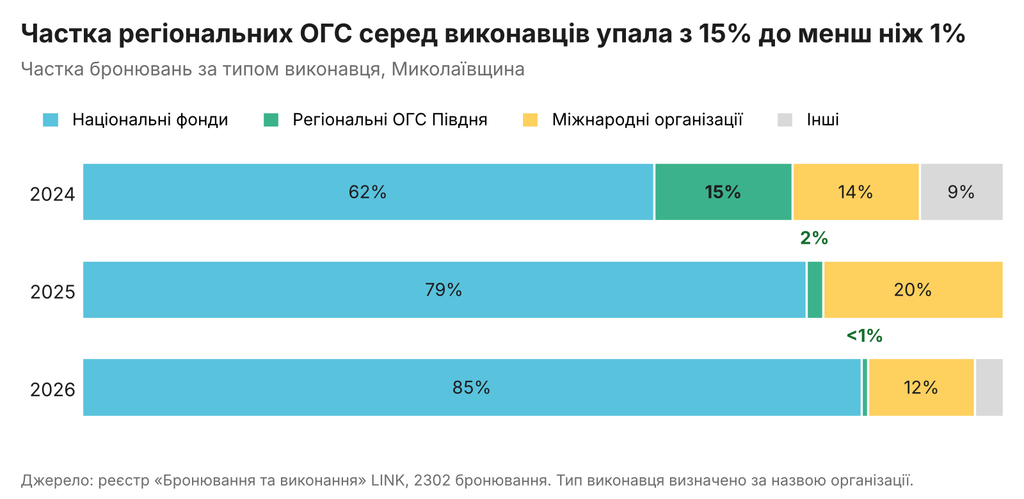
Of greatest concern is that regional civil society organisations from the South have almost stopped fulfilling bookings. International organisations consistently hold a share of 12–20% and work mainly on housing and water. Meanwhile, the share of national foundations grows every year.
Provider specialisation
The largest numbers of providers met needs in WASH (25 organisations), housing (20) and health (17). Only six providers were found for heating, two for services and one for animal care. Of the 36 partners, 17 work in a single cluster, and only eight work in four or five.
Several organisations jointly met a single need only 21 times out of 2,210 needs met, and 14 of these cases were in Bereznehuvate community. In almost all of them (19 out of 21), the needs were for bulk consumables such as hygiene kits and diapers, with partners splitting the volume between them.
The largest examples are in Zavodske community. In 2024, the Pomagaem Charitable Foundation and International Medical Corps jointly delivered 427 hygiene kits to Bilozirka and 110 to Partyzanske, one per household. In Prybuzke, Halytsynove community, DRC and the NGO Skadovsk Aktyv delivered 72 kits. In Novosevastopol and Tetianivka, Bereznehuvate community, three organisations delivered hygiene kits for vulnerable groups: the Volunteer UA International Charitable Foundation, the Pomagaem Charitable Foundation and the Rukh-Myloserdia Charitable Foundation.
Yet water towers, the fitting-out of outpatient clinics and roof repairs, where joint funding would make the most sense, have never been covered by several partners together.
Where more partners are active, needs are generally met more often. Shyroke and Mishkovo-Pohorilove communities, which have the lowest shares of needs met, had seven and eight partners respectively. Shevchenkove and Bereznehuvate had 24 and 20.
What should be done
- Start looking for partners for winter needs now. Heating and energy is the only cluster where the mechanism barely works. Before the heating season begins, partners working in the energy sector should be approached separately about the open requests, primarily for portable power stations.
- Bring regional organisations back. The fall in their share from 15% to less than 1% runs counter to the localisation agenda. The reasons should be identified, whether funding, access to the CSO account or competition with large foundations, and these organisations should be offered areas where they work faster than national foundations.
- Seek joint funding for complex needs. Water supply, the fitting-out of FAPs and outpatient clinics, and solar panels wait the longest. Such requests should be funded by several partners together. At present, this happens very rarely.
¹ In the OCHA coordination system, winter assistance (fuel, heaters, home insulation) falls mainly under the Shelter/NFI cluster. It is not the same as the LINK cluster “Housing and non-food items”.
Sources: the LINK platform register “All needs” (4,499 verified needs in Mykolaiv Oblast submitted between 23 October 2023 and 1 October 2026), the register “Bookings and fulfilment” (2,302 bookings from 13 February 2024 to 2 October 2026), and the list of representatives registered in the community account (53 people from Mykolaiv Oblast, excluding two test entries). Clusters follow LINK’s internal classification; needs assigned to several clusters are counted in each of them.
This material was prepared by the Legal Development Network in cooperation with the Czech humanitarian organisation People in Need and with financial support from the UK Government under the HAVEN project (Humanitarian Action through Volunteers, Enablers, and Networks).
The interpretation of LINK data is the authors’ own and does not necessarily reflect the views of the project’s partners or donor.
P. S. In June 2024, the Legal Development Network (LDN) launched a crowdfunding campaign, Recovery of The South of Ukraine , as part of the crisis response program #StandWithUkraine.

