Author: Yuliia Bilyk, Communications Manager at the Legal Development Network (LDN)
Kalynivska community in Beryslav Raion lies on the edge of Kherson Oblast, right on the border with Mykolaiv Oblast. Hostilities have noticeably reduced its population, and some villages have been left completely deserted. In these conditions, the community has developed a development strategy through 2034 for the first time. It was supported in this effort by the Legal Development Network (LDN), in cooperation with the Czech Humanitarian Organization People in Need and with funding from the UK government. We look at what it means to make long-term decisions when circumstances change every week.
A Strategy as a New Experience
Kalynivska community, centered on the settlement of Kalynivske, had never had a development strategy before, so creating one was an entirely new experience. Because of frequent shelling and drone attacks, working group meetings were held remotely. Even so, the community ensured cooperation across departments and involved representatives of target groups and local residents.
According to strategic planning expert Taras Rashkevych, the community’s executive staff were very active. Dmytro Vidiniei, Deputy Head of the Kalynivske Settlement, was directly involved in preparing the documents and collecting data for the socioeconomic analysis. This is how he describes the working atmosphere.
“The cooperation between the military administration, the settlement council, and the expert community is constructive. It allows us to take the community’s interests into account and look for compromise solutions instead of one-sided approaches,”
says Dmytro Vidiniei.
The first step toward the strategy was a survey in which residents shared their own vision of the community’s development priorities. The most striking finding is that in a community many people have left because of the threat of war, those who remain want to stay — and say they are ready to put in the effort to rebuild and develop their land.
Priority Areas of Development
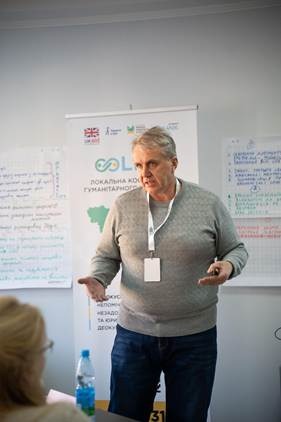
Strategic planning expert Taras Rashkevych
“While drawing up the action plan, we faced a question: should anything be rebuilt where there are no people? The impact of the war and the shrinking population determine which settlements in the community should get large-scale projects,”
says Taras Rashkevych.
The Kalynivka community’s strategic goal is economic growth and investment appeal, and within it, attracting investment and improving transport accessibility. But security comes first, as it affects every area of community life.
“Issue number one is security, starting with the most basic things: the points where people receive humanitarian aid need to be fitted with protective netting. The next important issues are modernizing housing and utilities infrastructure, above all the water supply of settlements, and improving the quality of education, health care, and social services,”
says Taras Rashkevych.
The strategy also provides for access to services in remote villages, opportunities for children and young people, employment, the restoration of economic activity, and the development of local self-government.
Robert Żarkowski, an expert engaged by the Legal Development Network (LDN) and director of the Foundation for the Development of Local Democracy in the West Pomeranian and Kuyavian-Pomeranian Voivodeships of the Republic of Poland, advises the community to keep people at the center of its attention.
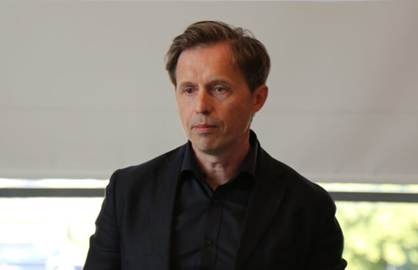
LDN expert Robert Żarkowski. Photo: uacrisis.org
“It is hard to give recommendations to a community living through war. Still, I always advise focusing first and foremost on measures that support people. Everything else should complement these priorities — important and effective, but still a complement,”
emphasizes Robert Żarkowski.
According to Taras Rashkevych, whether residents who have left will return depends on three factors.
“The first factor is schools and preschools for children, and medical facilities where people can receive first aid. The second is housing. The third is jobs and opportunities to start and grow a business. If there are no quality educational, cultural, and medical services, or no chance to work, people will not come back,”
explains Taras Rashkevych.
A Wider View of Opportunities
The community’s main direction of economic development is agriculture. Robert Żarkowski advises combining it with small business and processing, and creating a space where young people can carry out their own small projects. Taras Rashkevych also speaks of the potential for processing agricultural raw materials and for craft production by small enterprises.
Both experts cite the presence of railway stations as an advantage of the community. Although the stations are now destroyed, rebuilding them would make it possible to assemble and ship large consignments of agricultural products across Ukraine and abroad. This is a shared interest of the Kalynivka and Velykooleksandrivka communities — the latter being another community that LDN helped to develop a strategy. The experts therefore advise the communities to press jointly for the construction of quality roads along the railway corridors and transport and logistics hubs.
“Developing this kind of infrastructure serves the communities’ shared economic interests, as it will help improve transport accessibility, develop local production, and expand opportunities for selling products,”
explains Robert Żarkowski.
According to the expert, a similar approach to cooperation makes sense in the provision of utility services too, especially those that require significant financial outlays.
“Communities can jointly organize the collection and removal of household waste, and use shared infrastructure for its processing and disposal, including household waste landfills. Pooling resources and sharing infrastructure will make it possible to tackle tasks that are difficult or economically unviable for each community to carry out on its own, to optimize costs, and to improve the quality of services for residents,”
stresses Robert Żarkowski.
Overall, the expert encourages the Kalynivka and Velykooleksandrivka communities to position themselves as two partner communities. After all, cooperation and complementarity can create much better conditions for the development of each territory.
In the future, once the Inhulets River has been cleared of mines and other explosive ordnance, the villages of the Kalynivka community could develop recreation. Another resource not yet put to use is the region’s history.
“The community has an interesting historical heritage. In the 1920s, one of the first national Jewish districts was located here, and residents of what was then Kherson uyezd received substantial assistance from foreign philanthropic organizations. If we could restore ties with the Jewish people today, it would open up new opportunities for the community’s growth,”
says Taras Rashkevych.
Indeed, the community has preserved the synagogue building, Jewish cemeteries, and several other sites of Jewish cultural heritage. It is too early to talk about specific projects in this area, but the idea of creating a historical and tourist route is already under discussion.
The Prospect of International Cooperation
The Kalynivka community has a well-developed social sector and could become an example of quality support for people in times of crisis for other communities, not only in Ukraine but abroad as well. In particular, Robert Żarkowski sees potential in exchanging experience with Polish gminas.
“Polish local governments have considerable experience in creating and running social services centers (Centra Usług Społecznych), supporting older people and persons with disabilities, shaping local policy for these groups, organizing relevant services, and involving various institutions and organizations in delivering them. This experience could be useful to the Kalynivka community. At the same time, Polish partners would be interested in learning about Ukrainian practices of organizing social support in conditions of war and limited resources,”
explains Robert Żarkowski.
The expert stresses that Ukrainian communities should look abroad for partners, not aid providers. Partnership in crisis response is especially relevant. In Poland, for example, as in many other European countries, interest is now growing in the practical experience of Ukrainian communities that are forced to work in wartime conditions every day.
“Crisis preparedness and civil protection are now taking on particular importance in Poland. Significant financial resources are being directed to these areas, including to strengthen the capacity of gminas to respond to emergencies. This is an area in which Ukrainian communities can act not only as recipients of support but as full-fledged partners able to share their own knowledge and practical solutions.”
The expert also considers Ukrainian-Polish cooperation between cultural institutions and civil society organizations promising. After all, sector-level contacts often become the foundation for further partnership between local governments.
A Document That Delivers Results
In Dmytro Vidiniei’s view, the strategy that has been developed makes it possible to accomplish three key tasks:
● to define the community’s priority areas of development,
● to move from reacting to current problems case by case to planning long-term socioeconomic and cultural recovery,
● to direct the community’s available financial, material, and human resources rationally toward the most important projects.
Now the sequence in which the planned measures will be carried out must be determined, depending on the security situation and available resources. Civil society organizations, of which there are none here yet, could help the community attract additional resources.
“During both visits, I urged them to initiate the creation of a local organization. It takes time, but it would be useful, because it stimulates residents’ activity and helps them understand that much depends on them,”
stresses Taras Rashkevych.
LDN Project Manager Svitlana Seldina
“In the Kalynivka community’s strategy, we paid particular attention to education, opportunities for children and young people, employment, and the restoration of economic activity. The strategy also provides for the development of local self-government, resident participation, and the community’s capacity to respond to security and socioeconomic challenges,”
says Legal Development Network (LDN) Project Manager Svitlana Seldina, summing up the work.
How far-sighted the community and the experts have been in setting strategic goals, and how many of the planned projects can be implemented, will be shown by the established performance indicators. The developers are confident in the quality of the document, which complies with current legislation and reflects the community’s potential. At the same time, achieving one hundred percent of all indicators is not their goal.
“A strategy is not a document but a continuous, cyclical process, carried out by a team that grows professionally every year, accumulates experience, and sharpens its skills. The main result of this work should be a real improvement in the quality of life of the community’s residents,”
concludes Robert Żarkowski.
This material was prepared by the Legal Development Network (LDN) in cooperation with the Czech humanitarian organization People in Need and with funding from the UK government, as part of the HAVEN project — Humanitarian Action through Volunteers, Enablers, and Networks.
The views expressed by the experts are their own and do not reflect the views of the organizations or the donor.

