The Link local coordination mechanism for humanitarian response has been implemented for three years by the Legal Development Network in cooperation with the Czech humanitarian organization “People in Need,” with funding from the UK government. Link collects and verifies the needs of residents in de-occupied hromadas in Southern Ukraine, aiming to cover all settlements. We analyze how many people have already received assistance through Link and whether needs depend on the size of the settlement.
The Link mechanism operates in 352 settlements across 25 hromadas in Mykolaiv and Kherson Oblasts. Assistance covers 89.11% of all settlements. A key feature of the Link mechanism is its focus on the unseen and unmet needs of residents in de-occupied hromadas.
Population size of hromadas where Link operates
Data regarding the number of residents in settlements of de-occupied hromadas was obtained from informants. Over three years of operation, the Link platform has built its own network of informants within hromadas for the prompt collection and verification of residents’ needs. Currently, this network consists of 916 people. Verification of needs and demographic indicators takes place every two weeks.
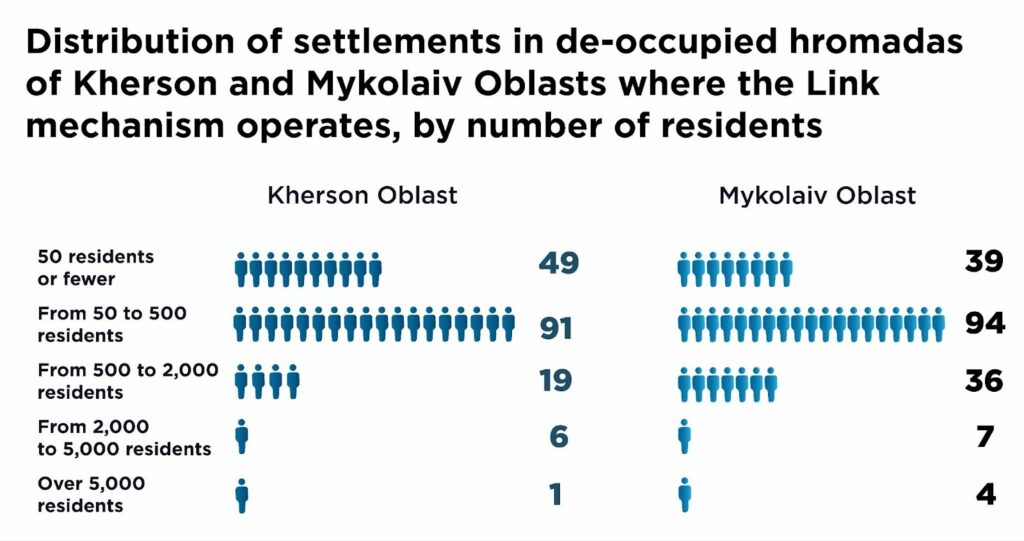
In both Oblasts, the largest number of settlements have a population ranging from 50 to 500 people. In second place are the smallest settlements, with fewer than 50 residents. This includes settlements with fewer than ten inhabitants. There are ten such settlements in Kherson Oblast and eight in Mykolaiv Oblast. In third place are settlements with a population of 500 to 2,000 residents. The smallest groups are those with over 2,000 and over 5,000 residents.
Distribution and Structure of Needs in Kherson Oblast Hromadas by Population Size
In total, 4,074 needs have been recorded in the de-occupied hromadas of Kherson Oblast where Link operates. Of these, 1,338 have been met (closed), and an additional 25 have been partially met.
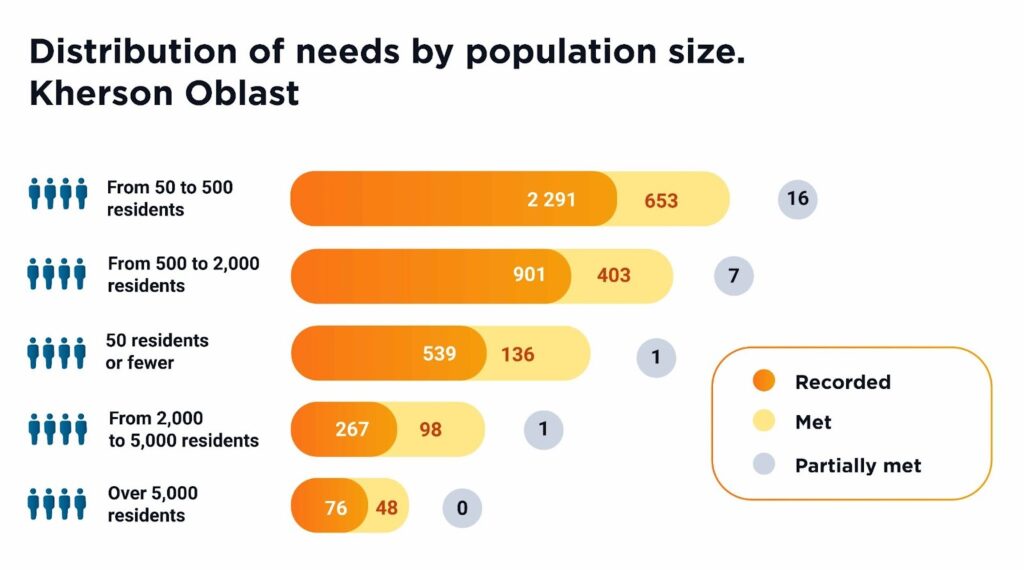
The number of recorded needs corresponds to the number of settlements: the highest number was recorded in settlements with a population of 50 to 500 people, while the lowest was recorded in a single settlement with more than 5,000 residents.
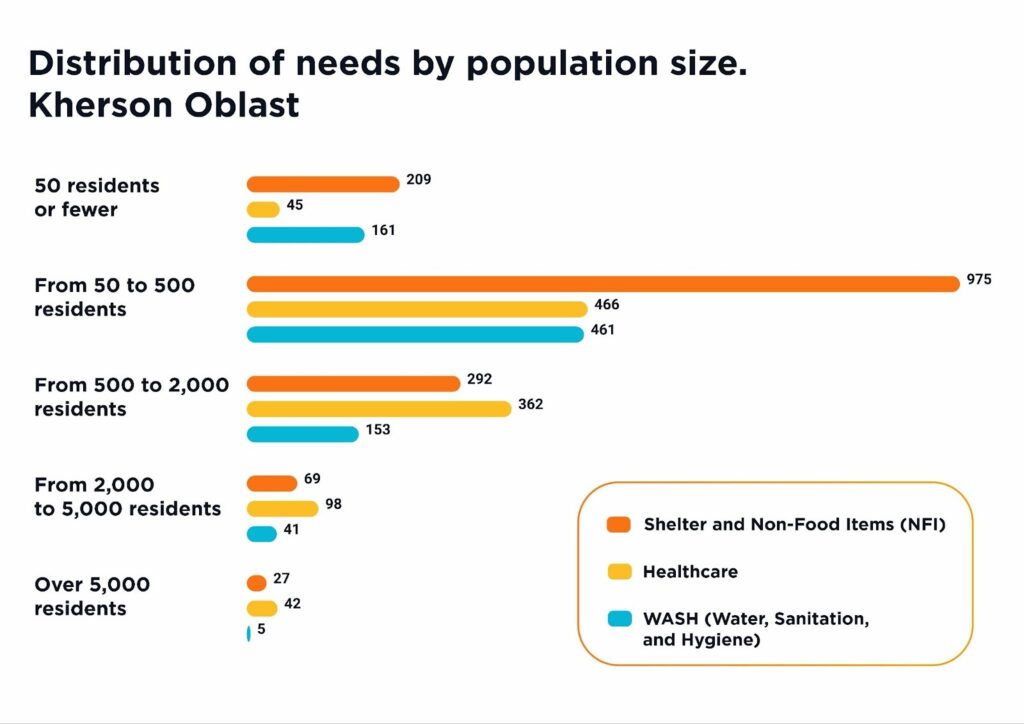
In all settlements of Kherson Oblast, the highest number of needs was recorded in the clusters of “Shelter and Non-Food Items,” “Healthcare,” and “WASH (Water, Sanitation, and Hygiene).” However, in smaller settlements with a population of 50 or fewer and 50 to 500 people, the “Shelter and Non-Food Items” category ranks first, while in larger settlements, the “Healthcare” cluster takes the top priority. A single met need may belong to two different clusters.
Distribution and Structure of Needs in Mykolaiv Oblast Hromadas by Population Size
In total, 2,562 needs have been recorded in the de-occupied hromadas of Mykolaiv Oblast where Link operates. Of these, 567 have been met, and an additional 16 have been partially met.
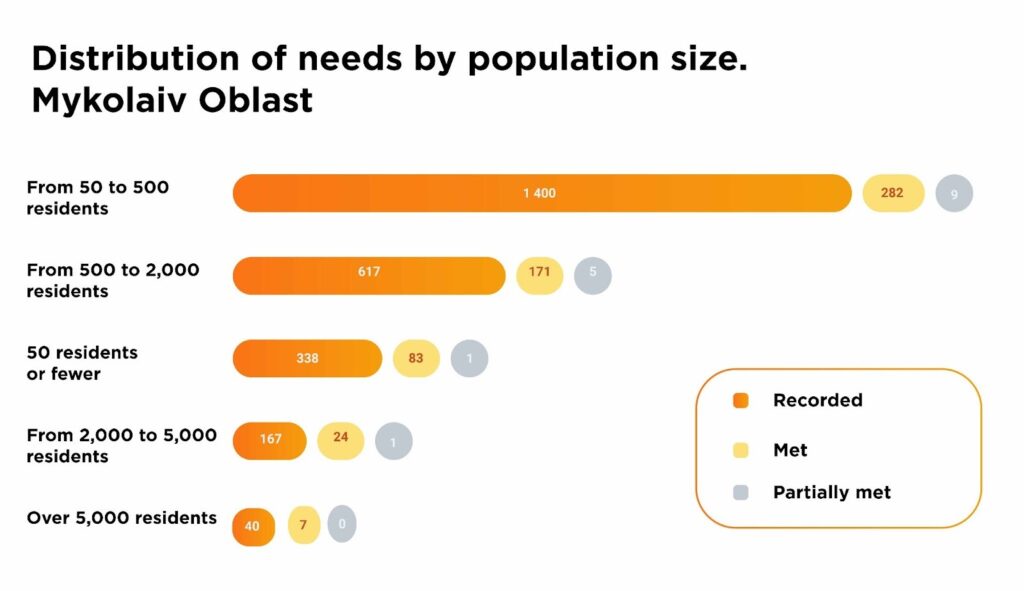
Significantly more needs were recorded in settlements with a population of 50 to 500 people, reflecting the larger number of settlements of this size in Mykolaiv Oblast.
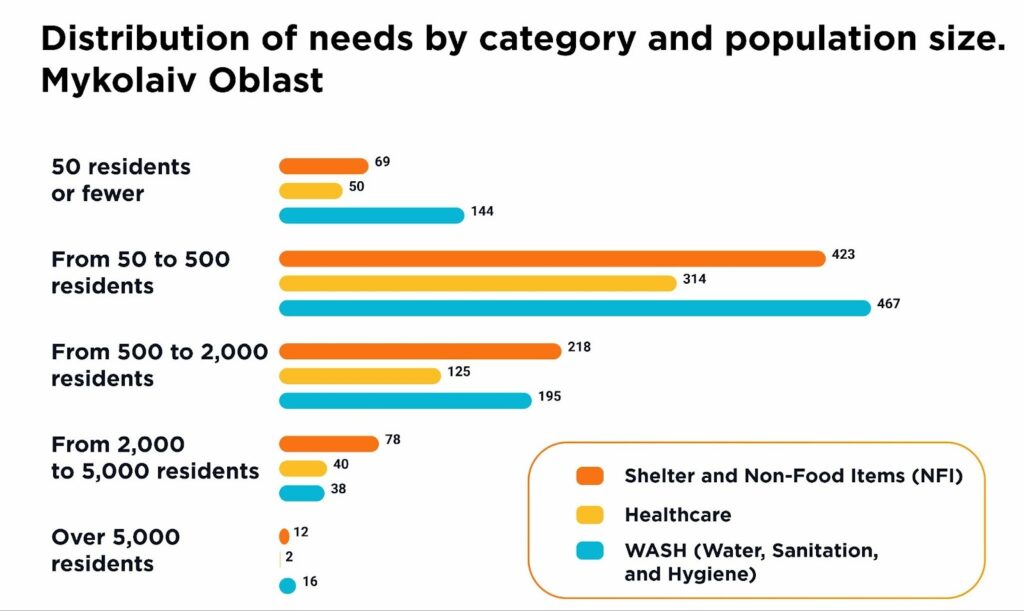
In Mykolaiv Oblast, the largest number of needs is concentrated in the same clusters as in Kherson Oblast. However, the distribution of requests within the three most frequent needs differs slightly. For instance, in most settlements, needs in the “WASH (Water, Sanitation, and Hygiene)” cluster rank first. In settlements with populations ranging from 500 to 2,000 and 2,000 to 5,000 people, needs in the “Shelter and Non-Food Items” cluster take the top priority. This highlights the complex water supply situation in the region, as water pipelines have been destroyed due to hostilities. A single met need may belong to two different clusters.
This material was prepared by the Legal Development Network in cooperation with the Czech humanitarian organization “People in Need” and with financial support from the UK Government.
The conclusions, interpretations of collected information, etc., expressed in this material are solely the position of the authors and do not reflect the opinions of the project’s donors and partners.

