Since September 2023, the Link local humanitarian response coordination mechanism—implemented by the Legal Development Network in partnership with the Czech humanitarian organization People in Needand supported by the Government of the United Kingdom—has covered the majority of settlements across 25 de-occupied communities in southern Ukraine. We analyze which needs are addressed most frequently and where assistance has not yet reached.
The Link mechanism operates in 352 settlements where at least one need has been identified. This represents 89.11% of all settlements in the de-occupied communities that Link aims to cover. The mechanism focuses on identifying overlooked and unmet needs and therefore seeks to reach the most remote and smallest villages. For example, the Link database includes needs reported from settlements with ten or fewer residents. More details can be found in the article “Who Needs What: Distribution of Humanitarian Requests by Settlement Size in De-Occupied Communities of the South.”
Coverage of settlements in Kherson Oblast
In seven out of fourteen de-occupied communities in Kherson Oblast, humanitarian assistance has reached all settlements, meaning that at least one humanitarian delivery has been made through the Link mechanism. These communities are: Borozenska, Velykooleksandrivska, Vysokopilska, Kalynivska, Novovorontsovska, Novooleksandrivska, and Novoraiska.
At the same time, in the Bilozerka, Daryivka, Kochubeivka, Muzykivka, and Chornobaivka communities, humanitarian assistance has reached between 40% and 60% of settlements where at least one need has been recorded.
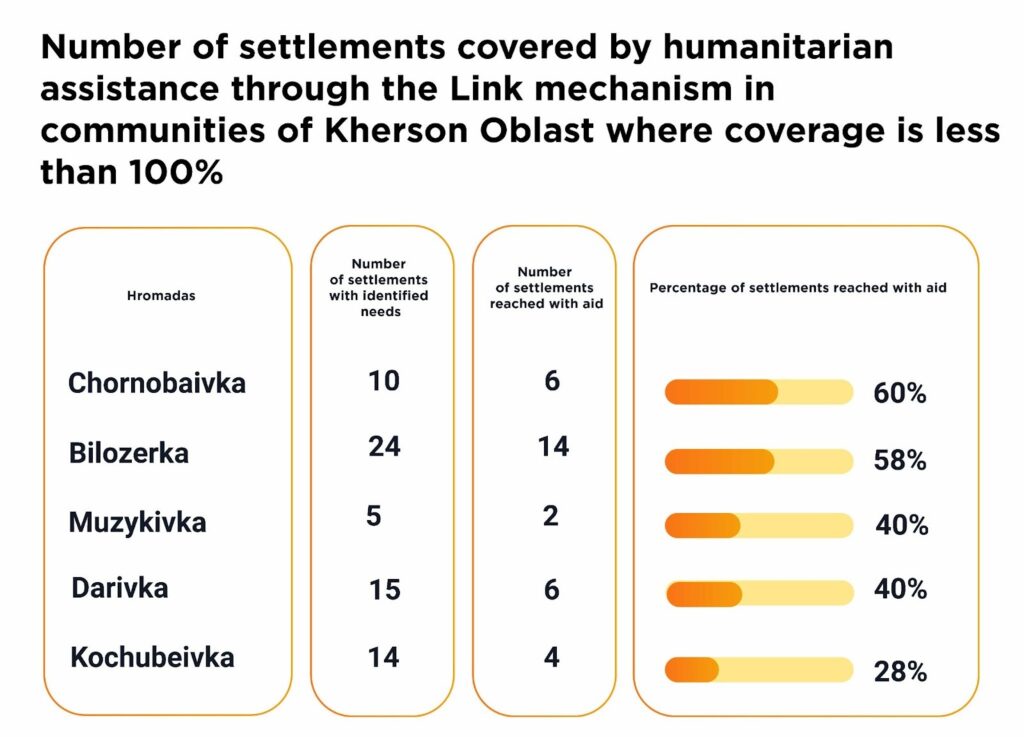
Thus, in Kherson Oblast, there are five communities where some settlements remain uncovered by humanitarian assistance, meaning that no aid has yet been delivered through the Link mechanism, despite the presence of identified and ongoing needs. In the Chornobaivka community, assistance has reached 60% of settlements, while in Bilozerka it has covered 58%. In the Muzykivka and Daryivka communities, 40% of settlements are covered. In the Dariivka and Kochubeivka communities, coverage stands at 24% and 28%, respectively.
It should be noted separately that, at present, no settlements in the Mylivska community have yet been covered by humanitarian assistance, as the community has only recently joined the mechanism and needs have just begun to be reported. The Kherson territorial community is also not included in this analysis, as it is not a target area for the Link mechanism.
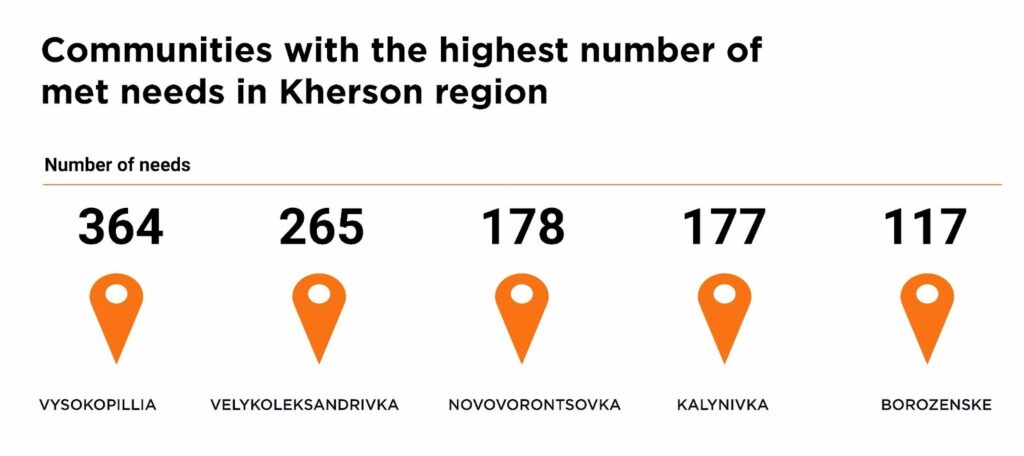
As of September 2025, the largest number of needs in Kherson Oblast have been addressed in the Vysokopilska, Velykooleksandrivska, Novovorontsovska, Kalynivska, and Borozenska communities. In the other communities of the oblast, fewer than 117 needs have been addressed.
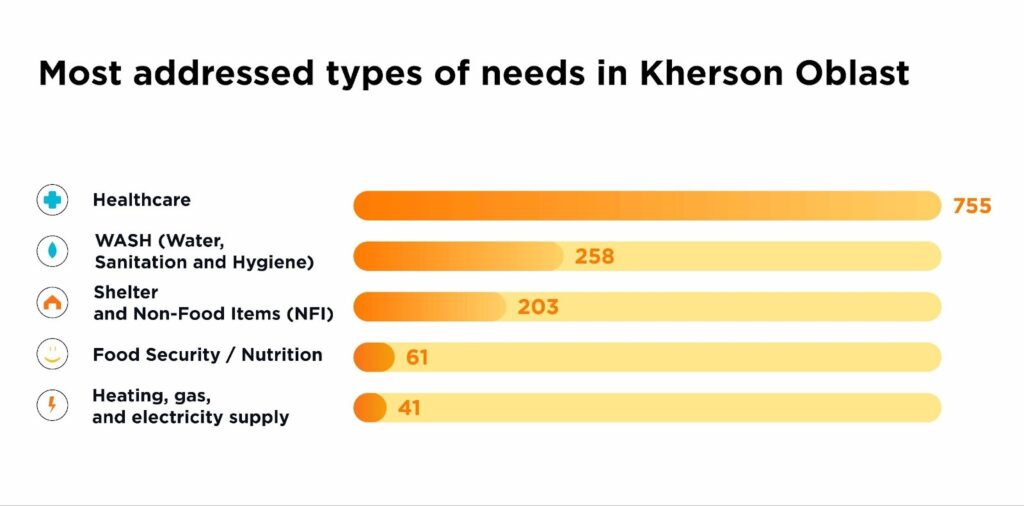
The vast majority of addressed needs fall within the Health cluster. The second and third most common categories are needs from the Water, Sanitation and Hygiene (WASH) cluster and the Shelter and Non-Food Items (NFI) cluster. Other types of addressed needs are significantly lower in number compared to these three leading clusters.
The infographic presents the clusters with the highest number of addressed needs; the list is not exhaustive. One addressed need may belong to two clusters.
Coverage of settlements in Mykolaiv Oblast
Out of 11 de-occupied communities in Mykolaiv Oblast, three are fully covered by humanitarian assistance: Inhulska, Halytsynivska, and Shyrokivska. This means that all settlements within these communities where needs have been identified have received at least one humanitarian delivery through the Link mechanism.
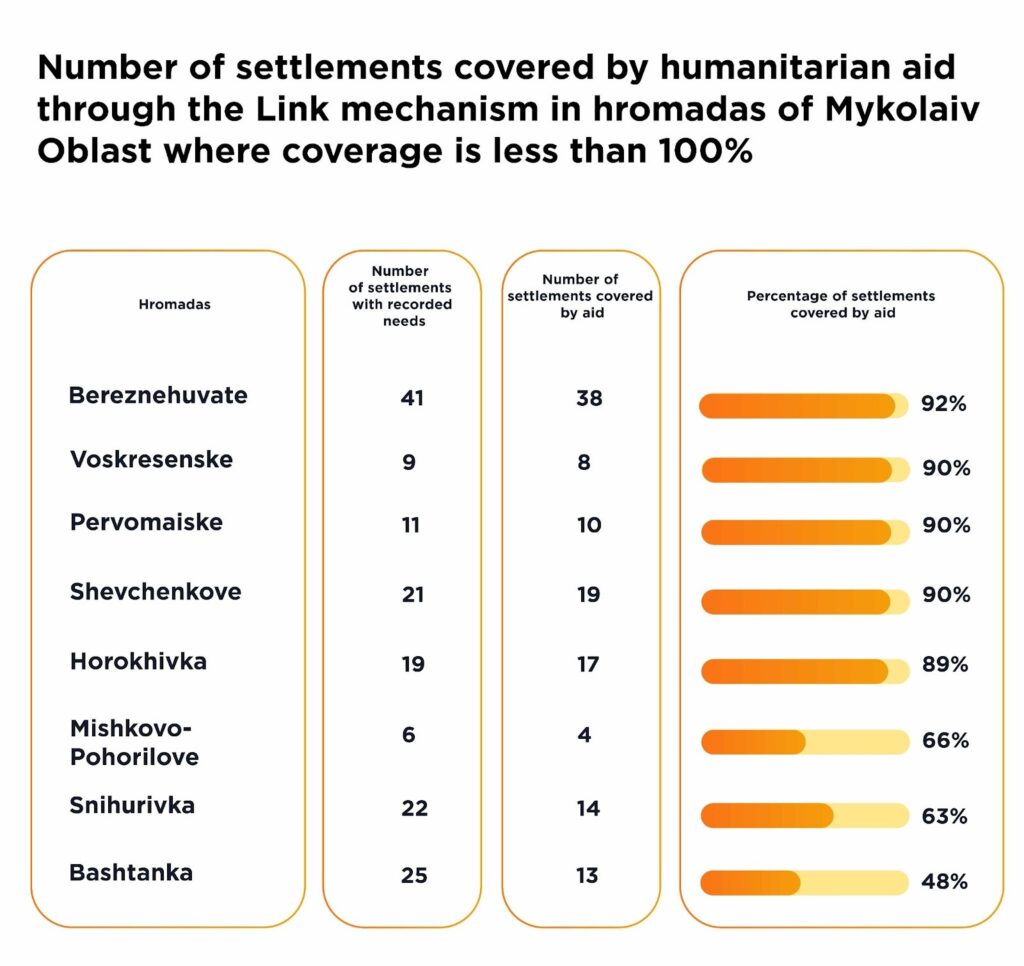
In the Pervomaiska, Shevchenkivska, Horokhivska, Voskresenska, and Bereznehuvatska communities, the level of coverage ranges from 89% to 90%. In the Snihurivska, Mishkovo-Pohorilivska, and Bashtanska communities, coverage stands at 63%, 66%, and 48%, respectively. The lowest levels of coverage are observed in the Bereznehuvatska and Voskresenska communities.
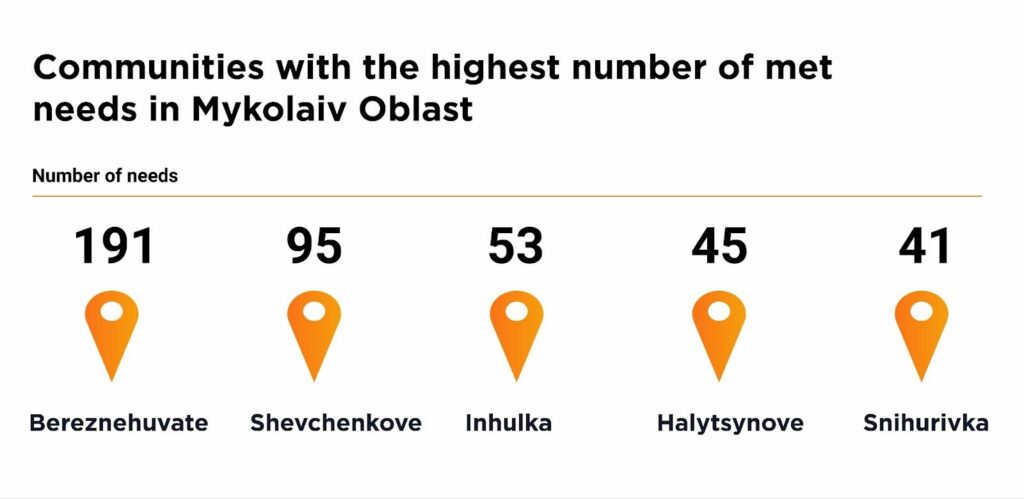
The largest number of needs were met in the Bereznehuvate community — 191. Far behind is the Shevchenkivska community, where 95 needs were met. In the Inhulska community, 53 needs were met; in the Halytsynivska and Snihurivska communities, 45 and 41 needs respectively. In other communities, fewer than 40 needs were met.
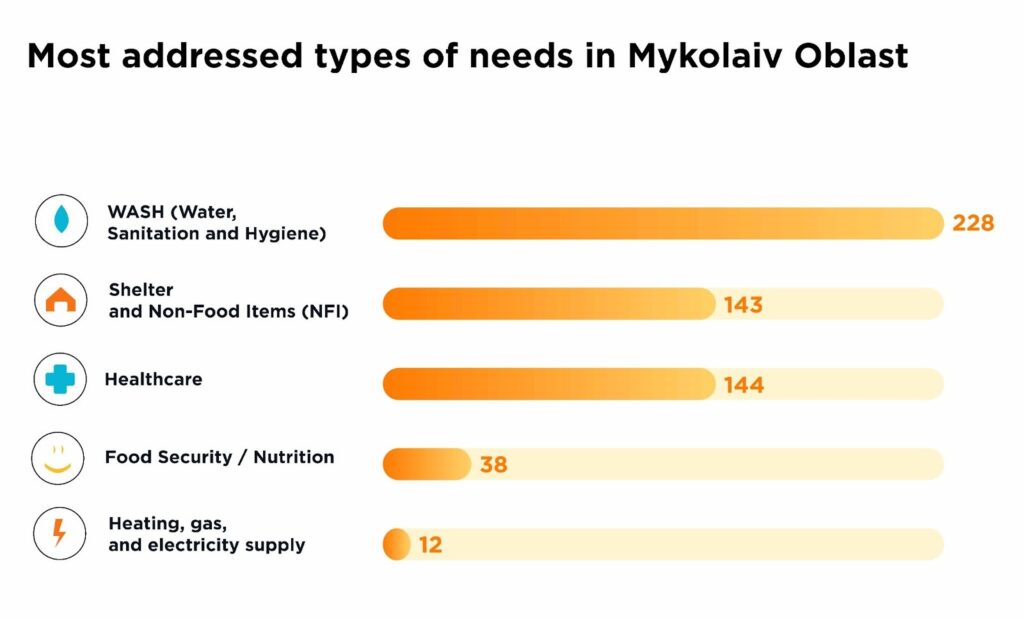
In Mykolaiv Oblast, the majority of closed needs fall under the “Water, Sanitation and Hygiene” cluster. The “Shelter and Non-Food Items” and “Health” clusters account for 143 and 144 closed needs respectively. In fourth place is “Food Security,” with 38 closed needs, followed by “Heating, Gas and Electricity Supply” in fifth place, with 12 closed needs. Other clusters have only isolated closed needs. One closed need may belong to two clusters.
This material was prepared by the Legal Development Network in cooperation with the Czech humanitarian organization People in Need and with the financial support of the Government of the United Kingdom.
The conclusions, interpretations of the collected information, and other views expressed in this material are solely those of the authors and do not necessarily reflect the views of the donors or project partners.

